

The ATEX (Atmosphères Explosibles) marking is a certification system that guarantees the safety of equipment used in environments where explosive atmospheres can form, such as in the oil, chemical or pharmaceutical industries. This marking ensures that equipment is designed to prevent the risk of explosion. It includes key information on the category of equipment, the types of gas or dust it can withstand, as well as temperature and safety conditions. Understanding this marking is essential for choosing the right equipment and complying with safety standards in these high-risk environments.
The CE mark certifies that the equipment has been assessed, tested and complies with all applicable European safety, health and environmental standards.
Notified bodies are independent entities accredited to assess the conformity of ATEX equipment to Directive 2014/34/EU. They carry out technical examinations, safety tests and issue certificates of conformity. Their unique code appears on the ATEX marking, attesting that the equipment complies with the safety standards required for use in hazardous atmospheres.
| 0035 | TÜV Rheinland Industrie Service GmbH | Germany |
| 0080 | INERIS(INSTITUT NATIONAL DE L'ENVIRONNEMENT INDUSTRIEL ET DES RISQUES) | France |
| 0081 | LCIE(LABORATOIRE CENTRAL DES INDUSTRIES ELECTRIQUES) | France |
| 0637 | IBExU Institut für Sicherheitstechnik GmbH | Germany |
| See more | ||
In the ATEX marking, I or II indicate the environments in which the equipment may be used.
- Mining and underground work
- Surface industries
The risk zone classification of ATEX equipment determines the level of explosion risk in a given zone, based on the probability and duration of an explosive atmosphere. If a piece of equipment is certified for a zone, this also covers less risky categories.
| Category | Zones | Risk of explosion | Risk frequency | Level of protection required | |
|---|---|---|---|---|---|
| Gas | Dust | ||||
| 1 | Zone 0 | Zone 20 | high | Permanent presence (> 1000 h/year) | Very high |
| 2 | Zone 1 | Zone 21 | medium or low | Occasional presence (10-1000 h/year) | high |
| 3 | Zone 2 | Zone 22 | very low | Présence rare (< 10 h/an) | medium |
- Gases and vapors
- Dust
CENELEC (Comité Européen de Normalisation en ÉLECtronique et en ÉLECtrotechnique) is an international organization that guarantees the quality of electronic devices through standards. The Ex sign on a product's norm mark guarantees that it conforms to CENELEC standards.
The protection mode in an ATEX marking designates the method used to ensure that equipment does not cause an explosion in a hazardous atmosphere. It specifies how the equipment is designed to prevent explosion hazards depending on the nature of the environment.
| Protection mode | Symbols | Principle | Sub-symbols | Zones | |
|---|---|---|---|---|---|
| G* | D** | ||||
Explosion-proof | d | Explosion-proof enclosure. No propagation of ignition source | da db dc | 0 1 2 | |
Enhanced safety | e | Increased safety protection mode. Suppression of ignition source | eb ec | 1 2 | |
Intrinsic safety | i | Intrinsic safety. Limitation of electrical energy below the minimum ignition threshold. | ia ib ic | 0 1 2 | 20 21 22 |
Internal overpressure | p | Protection mode by introduction of overpressure gas Blocking of any ATEX within the tool envelope | px py pz pb pc | 0 1 2 | 21 22 |
Powder filling
| q | Introduction of powdery material (quartz, sand, etc.) Blocking sparks or arcs | q | 1 | |
Oil immersion | o | Protection mode by immersion of electrical circuit in oil Isolation of the circuit from any ATEX | ob oc | 1 2 | |
Encapsulation | m | Encapsulated electronics protection mode Encapsulation of electronics in electrically insulating material | ma mb mc | 0 1 2 | 20 21 22 |
Waterproof case | t | Protection mode with sealed housing Dust-tight enclosure with limited surface temperature | ta tb tc | 20 21 22 | |
Enhanced safety(special cases) | n | nA: non-sparking device nC: Spark-producing device, with adequate protection nL: Limitation of energy production nR: Limited contact with outside circuit | nA nC nL nR | 2 2 2 2 | |

The criteria for classifying gas and dust groups under the ATEX Directive are based on specific physico-chemical characteristics, making it possible to assess their potential to cause an explosion and to establish safety requirements for the design and use of equipment in hazardous environments. Certification for a more hazardous ATEX group also covers less hazardous groups of the same type of atmosphere (group IIB covers group IIA and group IIIC covers groups IIIB and IIIA).
| Gas Groups | Examples of gases | Dust Groups | Examples of dust |
|---|---|---|---|
| I | Methane (mining) | ||
| IIA | Propane | IIIA | Combustible lint |
| IIB | Ethylene | IIIB | Non-conductive dust |
| IIC | Hydrogen/Acetylene | IIIC | Conductive dust |
The auto-ignition temperature of a gas (G) or dust (D) is the temperature at which the product ignites spontaneously in the presence of air, without an external ignition source (spark, flame, electric arc, etc.). To prevent this phenomenon in ATEX zones, it is essential to limit the maximum surface temperature that equipment can reach. ATEX temperature classes therefore determine this maximum temperature for equipment used in explosive atmospheres.
For gases and vapors (G), the closer the class is to T1 (450°C), the higher the maximum temperature allowed for the equipment, thus reducing the risk of self-ignition. Conversely, a class close to T6 (85°C) implies a lower maximum temperature, thus increasing the risk of self-ignition.
For dust (D), the maximum surface temperature is specified directly, e.g. T120°C, which determines the maximum temperature the equipment can reach in these environments.
Temperature class
Maximum achievable temperature
The level of protection in the ATEX marking is an indication of the safety of equipment intended for use in explosive atmospheres. It determines the equipment's ability to operate safely in an ATEX zone, based on the probability of an explosive atmosphere occurring and the duration of its presence.
| Location | I | II | ||||
|---|---|---|---|---|---|---|
| Category | M1 | M2 | 1 | 2 | 3 | |
| Equipment Protection Level (EPL) | Gases/Vapors (G) | My | Mb | Ga | Gb | Gc |
| Dust (D) | Da | Db | Dc | |||
The operating ambient temperature for ATEX equipment refers to the temperature range within which equipment intended for use in an ATEX Zone can operate safely, without compromising its integrity or creating an explosion hazard.
Equipment must be designed to operate in environments where the ambient temperature may vary, but the ATEX standard imposes limits to ensure safety. This range is generally indicated in the equipment's technical documentation or marking.
It is referred to as Tamb, but can also be referred to as Ta. This is not necessarily present on all devices, and if it is absent, the standard range is -20 °C ≤ Ta ≤ 40 °C.
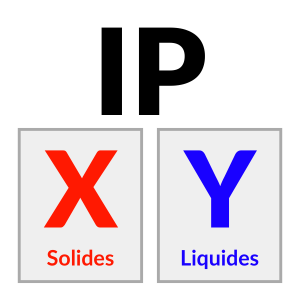
The IP rating (for Ingress Protection) is an international standard (IEC 60529) that classifies the level of protection offered by an enclosure or electrical equipment against the ingress of solids (such as dust) and liquids (such as water).
| X | Level of protection against Solids | Y | Liquid protection level |
|---|---|---|---|
| "0" | No Protection | "0" | No Protection |
| 1 | Protection against solid objects of 50 mm or more (e.g. hand) | 1 | Protection against vertical water drops (e.g. condensation) |
| 2 | Protection against solid objects 12.5 mm and larger (e.g. fingers) | 2 | Droplet protection at inclinations up to 15° from vertical |
| 3 | Protection against solid objects 2.5 mm and larger (e.g. tools, cables) | 3 | Droplet protection up to 60° from vertical (e.g. rain) |
| 4 | Protection against solid objects 1 mm and larger (e.g. cables, wires) | 4 | Protection against water spray from all directions |
| 5 | Limited protection against dust (does not affect operation) | 5 | Protection against water jets from all directions (e.g. from a hose) |
| 6 | Total protection against dust | 6 | Protection against strong jets of water (e.g. sea spray) |
| 7 | Protection against temporary immersion in water | ||
| 8 | Protected against prolonged immersion in water *. |
*conditions specified by the manufacturer
Fill in the form below to apply for the position of : General information on ATEX marking
Fill in the form below to submityour unsolicited application