Electric heating and cooling solutions for industry

Calculation method for heating a volume of liquid

How do you determine the power required to heat a volume of liquid?

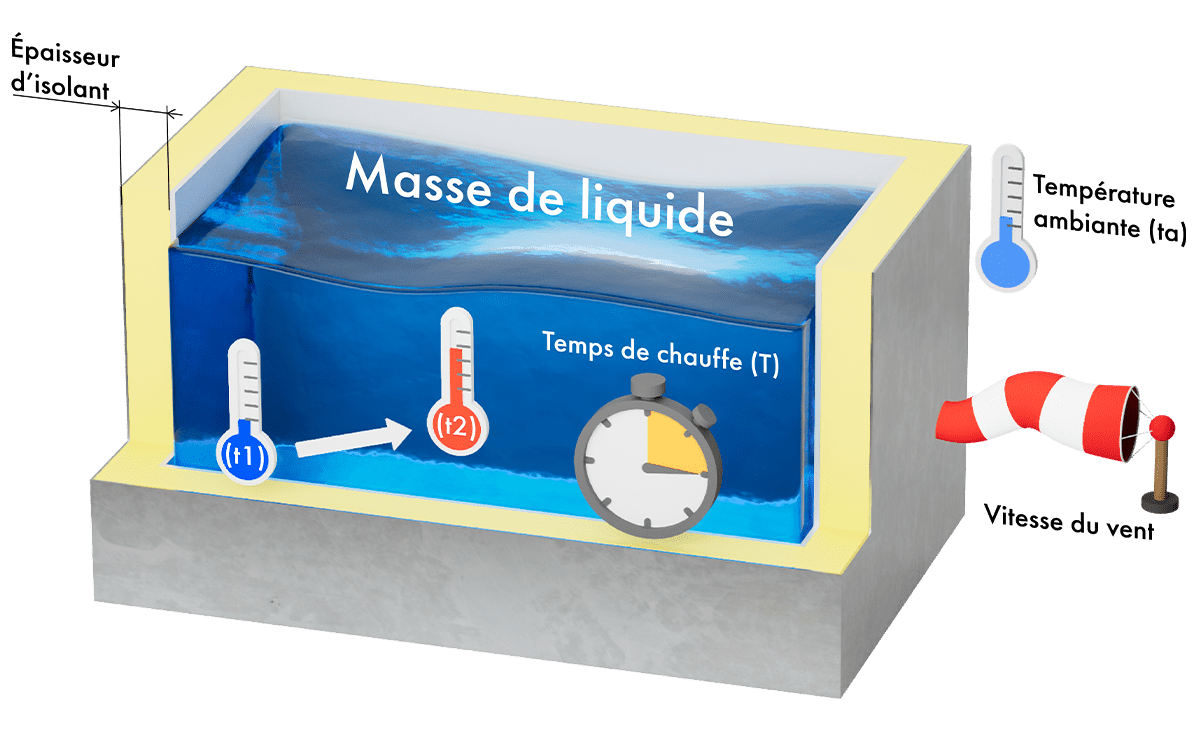
The power required to raise the temperature of a volume of liquid in a tank over a given period of time is the result of 2 calculations: the power required to raise the temperature of the liquid (Pch) and the heat loss (Pth).

Power to be installed (kW) = (kW)

+

Heating capacity calculation (Pch)

group 269
  • Heating capacity: Pch (kW)
  • Liquid mass: M (kg)
  • Specific heat of liquid: Cp (kcal/kg .°C)
  • Flow temperature: t1 (°C)
  • Desired final temperature: t2 (°C)
  • Heating time: T (h)
  • Safety factor: 1.2

Calculating the mass of liquid to be heated (M)

m v × ρ
  • Liquid mass: M (kg)
  • Volume of liquid to be heated: V (dm3 or liter)
  • Liquid density: ρ (kg/dm3)
Density ρ of some liquids (kg/dm3)
  • Water: 1
  • Mineral oil: 0.9
  • Bitumen: 1.1
  • Acetic acid: 1.1
  • Hydrochloric acid: 1.2
  • Nitric acid: 1.5
 
Specific heat Cp of some liquids (kcal/kg.°C)
  • Water: 1
  • Mineral oil: 0.5
  • Bitumen: 0.58
  • Acetic acid: 0.51
  • Hydrochloric acid: 0.6
  • Nitric acid: 0.66
Calculating liquid volume (V)
Cylindrical tank
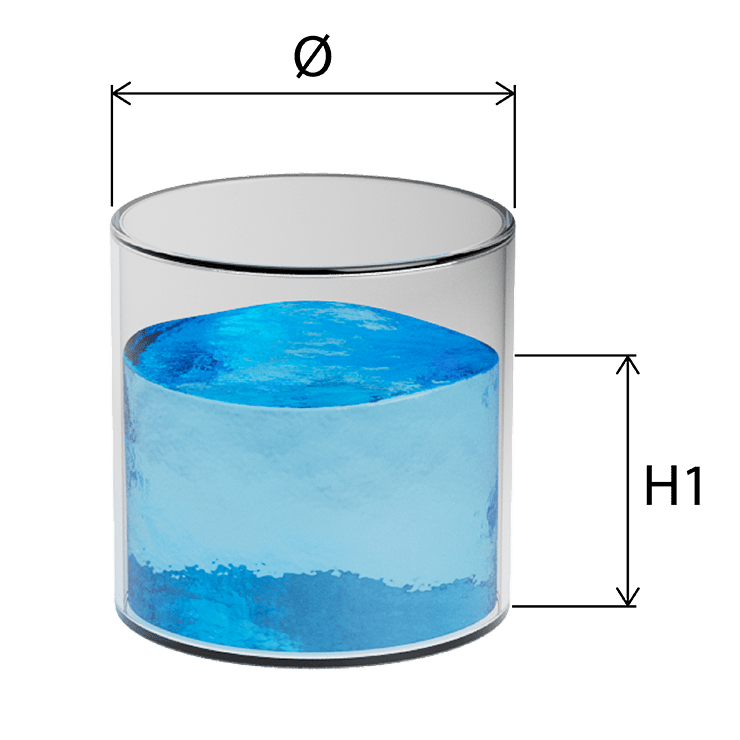
v = π × (ز ÷ 4) × h1
  • Volume of liquid to be heated: V (dm3 or liter)
  • Tank diameter: Ø (dm)
  • Liquid height: H1 (dm)
image cylindrical tank h1

Rectangular tank

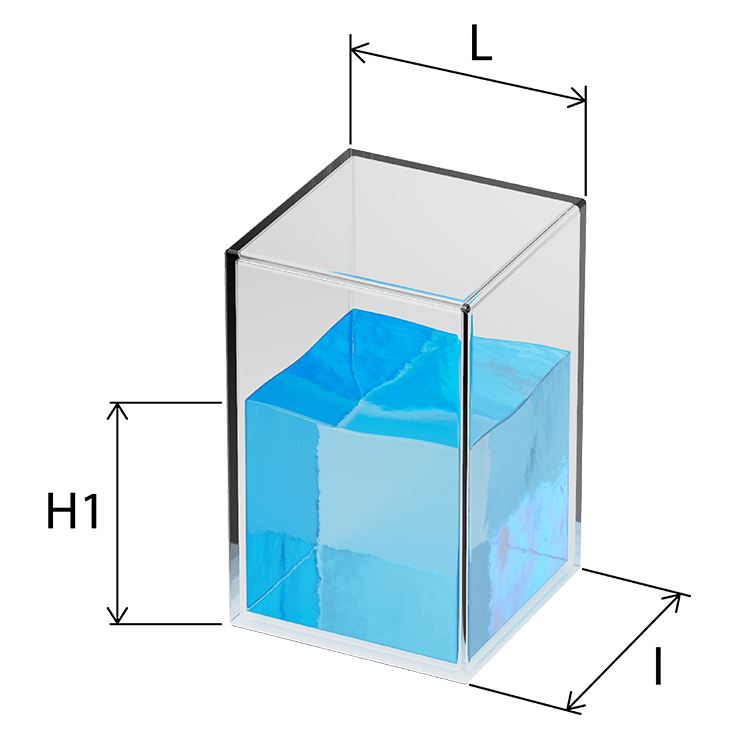
v = l × l × h1
  • Volume of liquid to be heated: V (dm3 or liter)
  • Tank length : L (dm)
  • Tank width: l ( dm)
  • Liquid height: H1 (dm)
image rectangular tank h1

Calculation of power required to compensate for heat loss (Pth)

group 269 1
  • Heat losses: Pth (kW)
  • Tank exchange surface: S ( m2)
  • Desired final temperature: t2 (°C)
  • Ambient temperature: ta (°C)
  • Heat transfer coefficient: K (kcal/h.m2.°C)
  • Safety factor: 1.2
Exchange coefficient (K)

The heat exchange coefficient is a physical quantity that quantifies the capacity of a fluid (liquid or gas) to transfer heat to a solid surface in a convective heat exchange .

Here are some values for the K exchange coefficient as a function of wind speed and insulation thickness:

Tank locationInsulation thickness (mm)
Without2550100
Indoor tank91.710.55
Outdoor tank - Wind ≤ 10 km/h12 2.1 1.1 0.59
Outdoor tank - Wind ≤ 45km/h302.31.20.61
Outdoor tank - Wind ≤ 90km/h492.41.30.62
Tank exchange surface (S)

Cylindrical tank

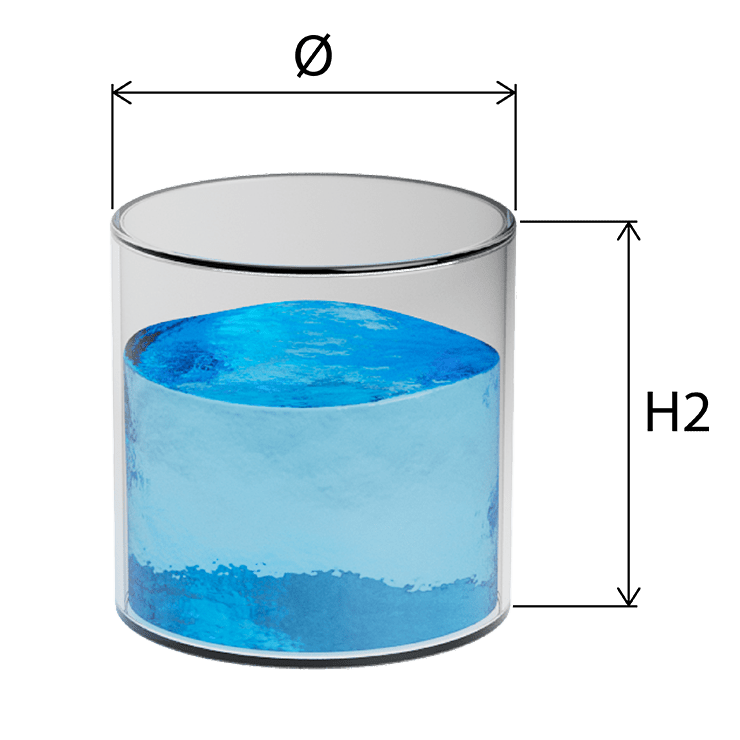
s = (π × Ø² ÷ 4)) + (π × Ø × h2)
  • Tank surface area: S (m2)
  • Tank diameter: Ø (m)
  • Tank height: H2 (m)
image cylindrical tank h2

Rectangular tank

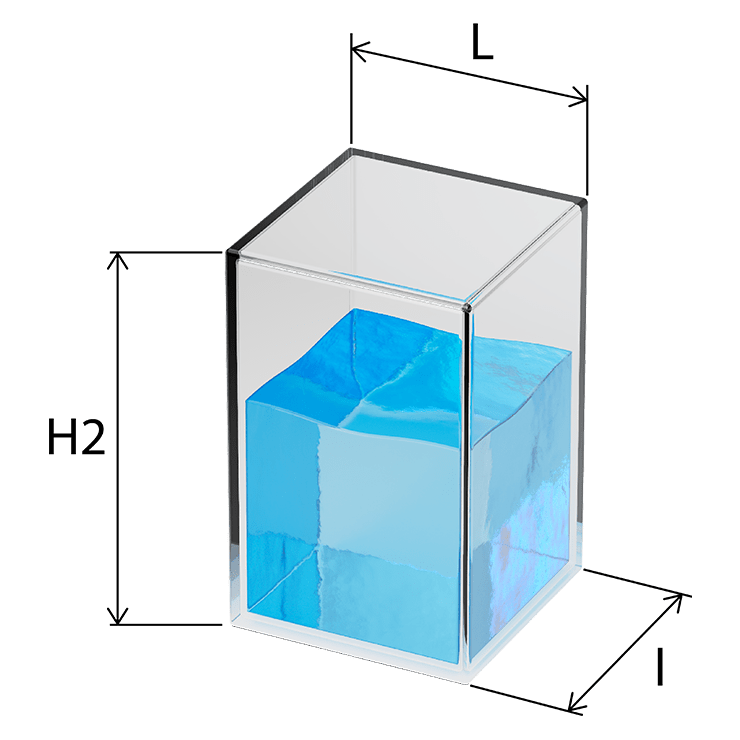
s = ((l + l ) × h2 × 2) + (l × l)
  • Tank surface area: S (m2)
  • Tank length : L (m)
  • Tank width: l (m)
  • Tank height: H2 (m)
image rectangular tank h2

Fill in the form below to apply for the position of : Calculation method for heating a volume of liquid

* All fields must be completed

Fill in the form below to submityour unsolicited application

* All fields must be completed