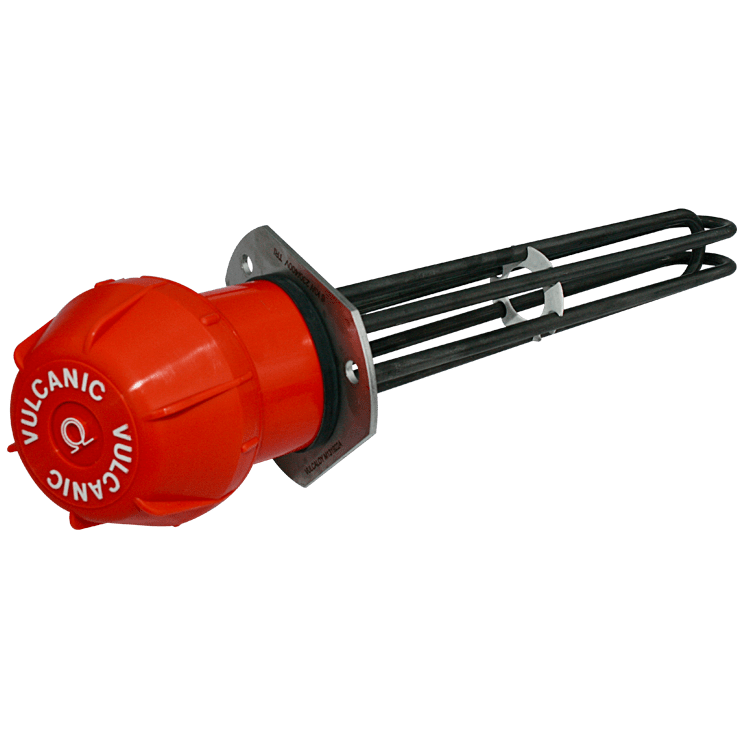
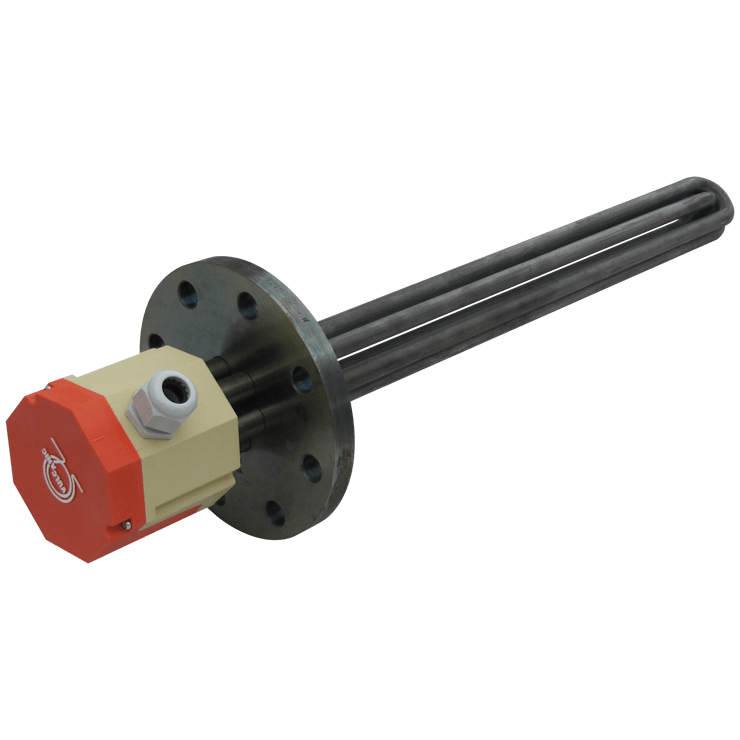
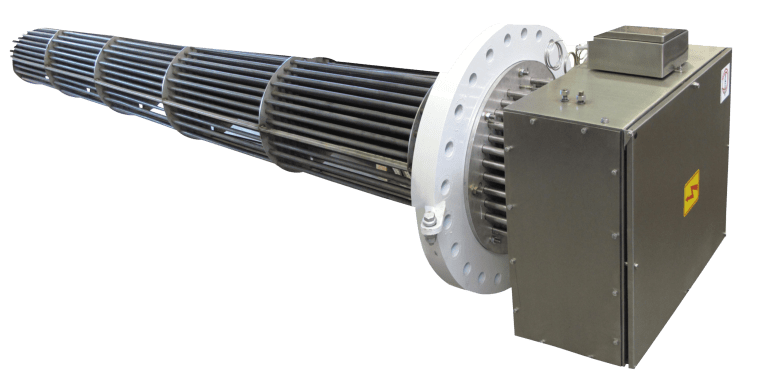
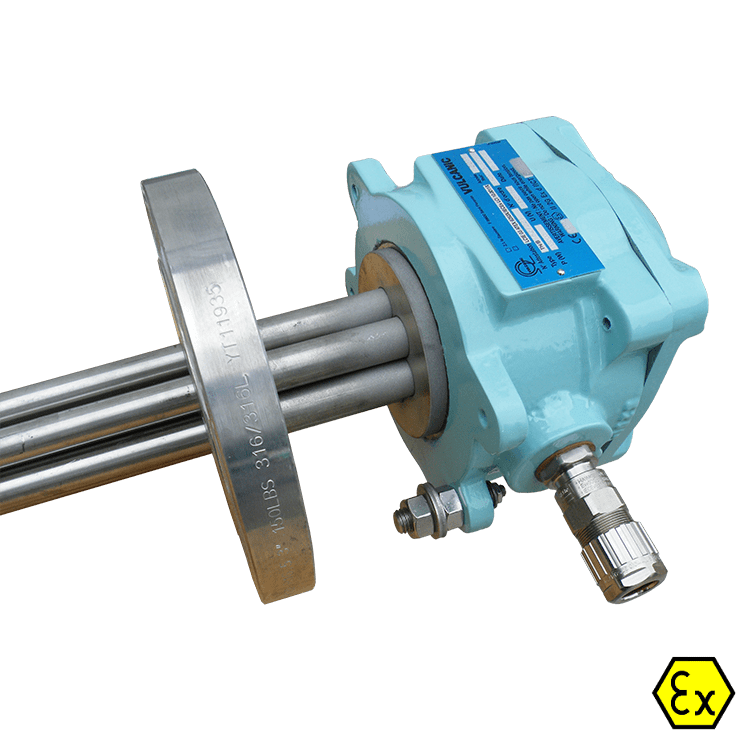
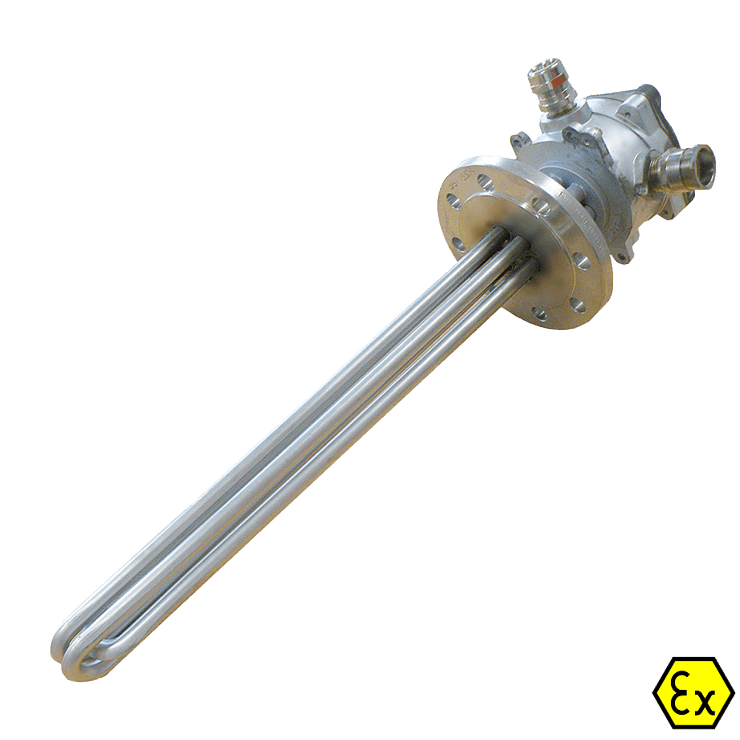
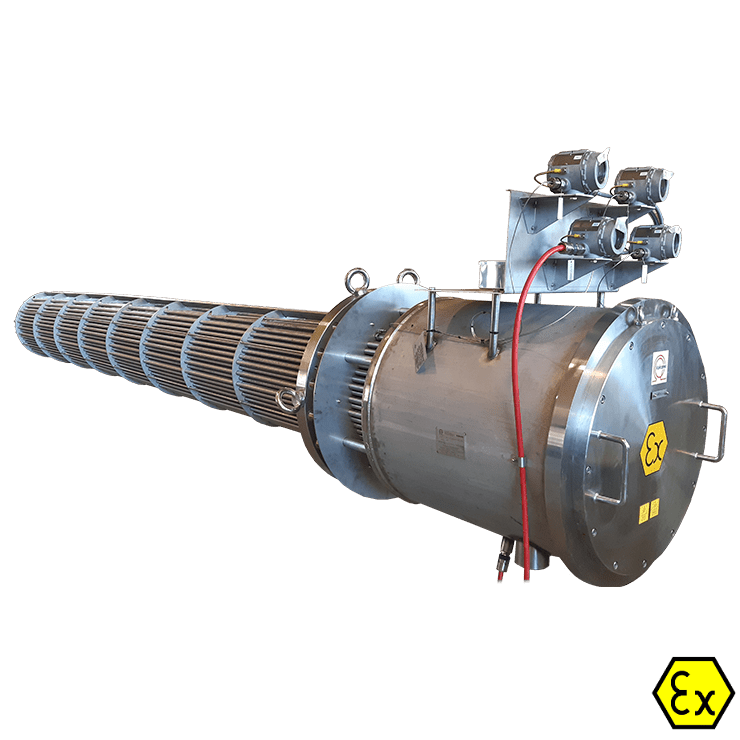
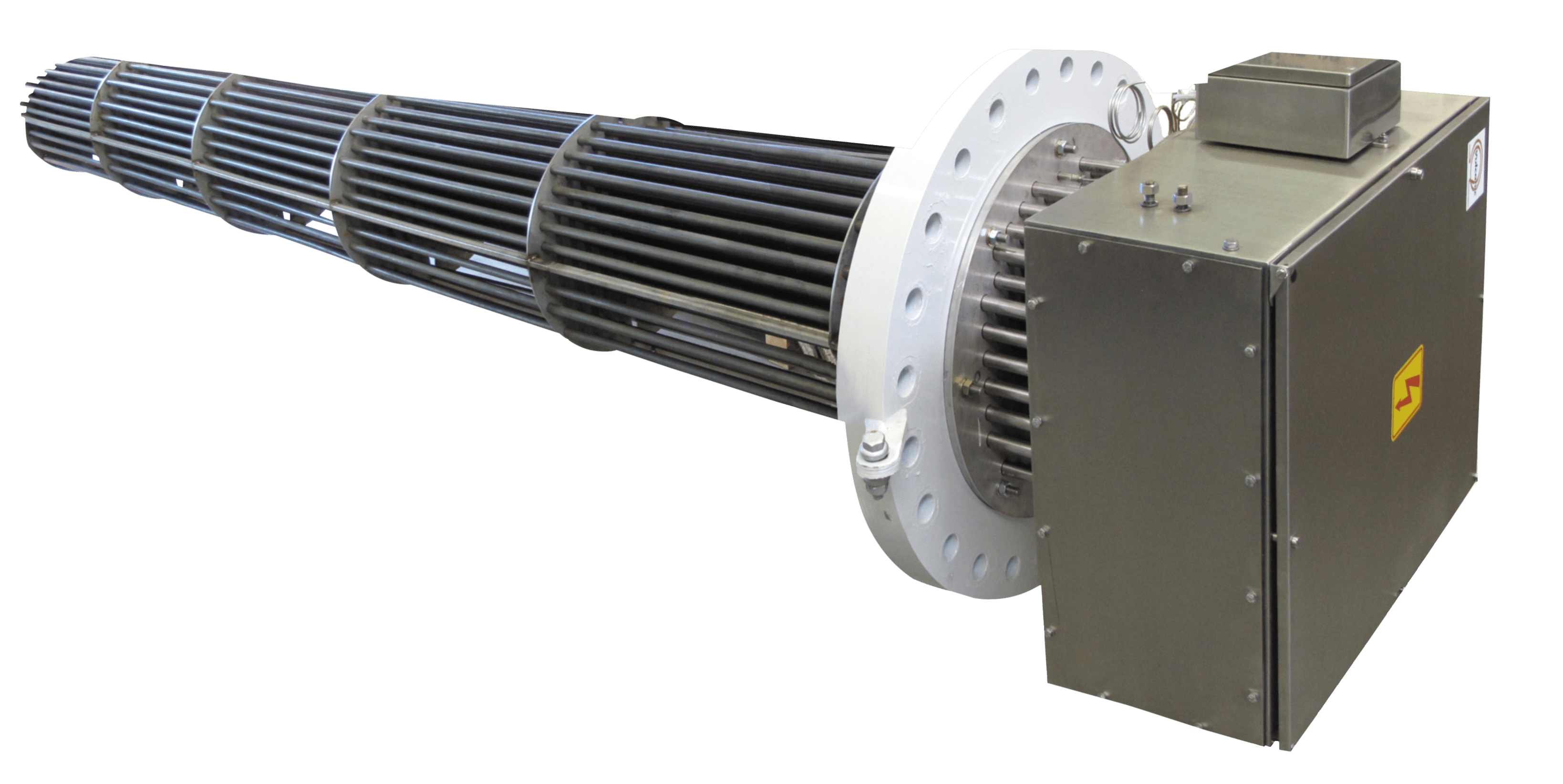
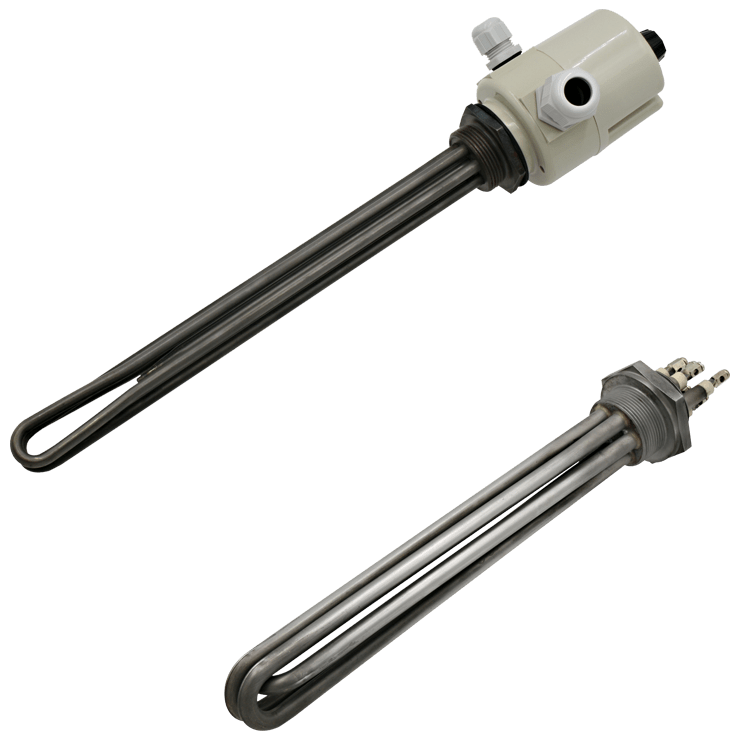
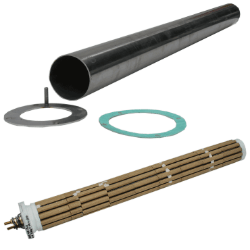
Flange-mounted electric immersion heaters are designed to raise the temperature of static liquids (water, oil, acid, soda, bitumen, etc.) or gases (air, nitrogen, CO2, etc.) in a tank or hot-water cylinder, or by forced convection in a circulating fluid heater. They are made up of a set of single-tube or pin-shaped shielded heating elements, available in different materials compatible with the fluids to be heated, or high-flux rods (made of boron nitride). The external shielding of the heating elements guarantees protection against physical aggression and corrosion.
The heating elements are welded, brazed or bycoupled to a standard round flange (EN 1092-1, ASME B16.5, STAMP-U, etc.) or to a special flange (triangular, square, etc.) according to customer requirements. This fitting allows watertight installation up to over 300 bar (365 bar on a DN 12″).
Flange immersion heaters can be fitted with control and safety devices (thermostats, Pt100 probes, thermocouples) with temperature measurement in the fluid or on the shielded elements, and with an electrical box to protect the connectors.
Applications
Screw plug immersion heater capable of heating or maintaining the temperature of a wide variety of fluids (domestic or sea water, lubricants, vegetable, animal or hydraulic oils, fuel oil, degreasers, acids, etc.). As a result, these immersion heaters are used in a number of sectors, including petrochemicals, gas, energy, manufacturing, healthcare, automotive, and the environment.
They are mainly found in :
Facilities management
In the cement plant, oil and fuel oil are preheated to preserve a maximum of elements and reduce the release of harmful particles into the air when these fluids are burned.
Gas, Oil and Petrochemicals
Flange immersion heaters are widely used in the oil industry, from drilling platforms to refineries. They are used to maintain the temperature of oil, or to heat various fluids (LNG, glycol, methane, etc.).
In gas plants, these submerged elements are used to heat air, hydrogen and oxygen.
Energy sector
An energy storage project is being set up to help decarbonize the energy sector. Special flanged immersion heaters will be used to melt salts, in order to conserve excess energy emitted by power plants that is currently unusable.
Technical data
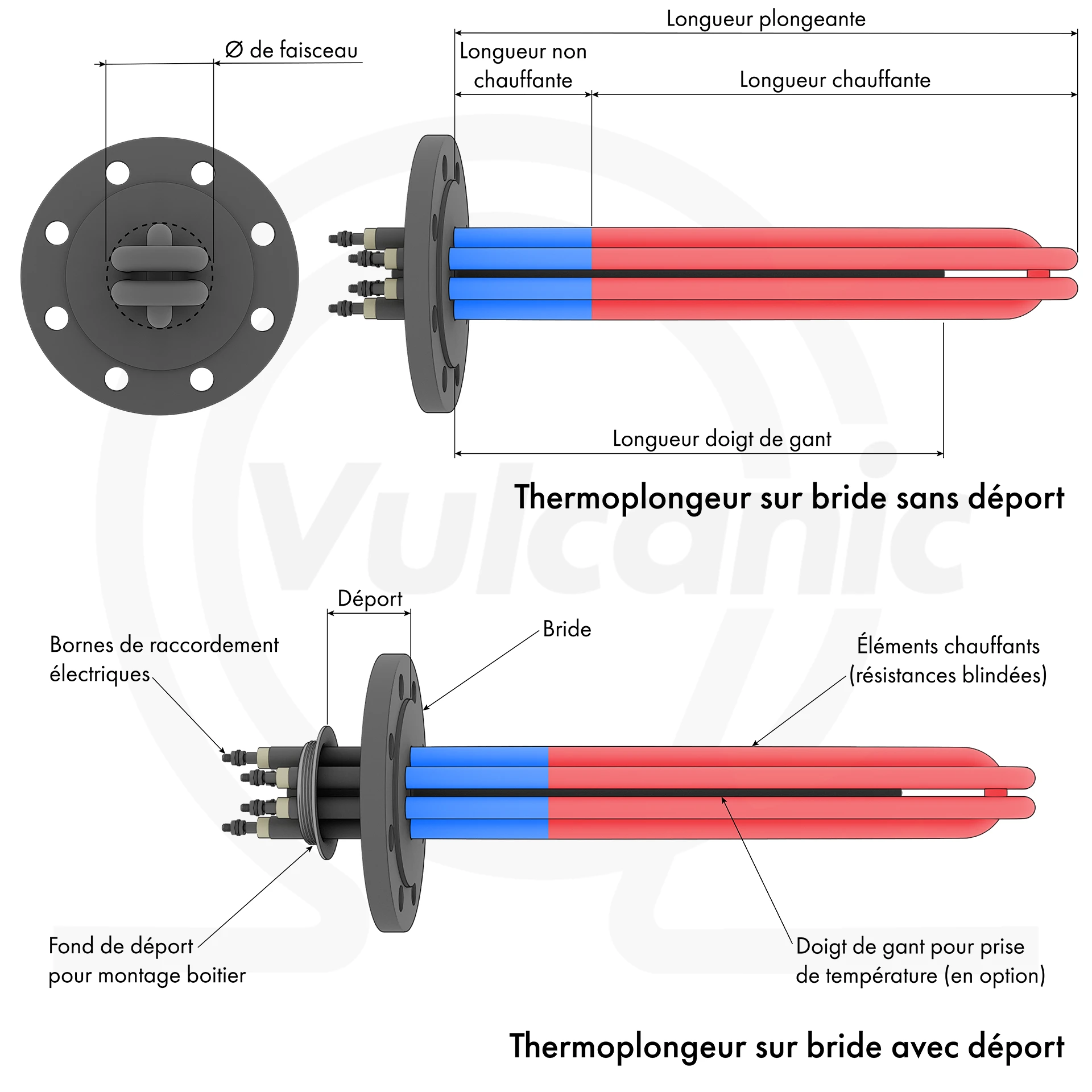
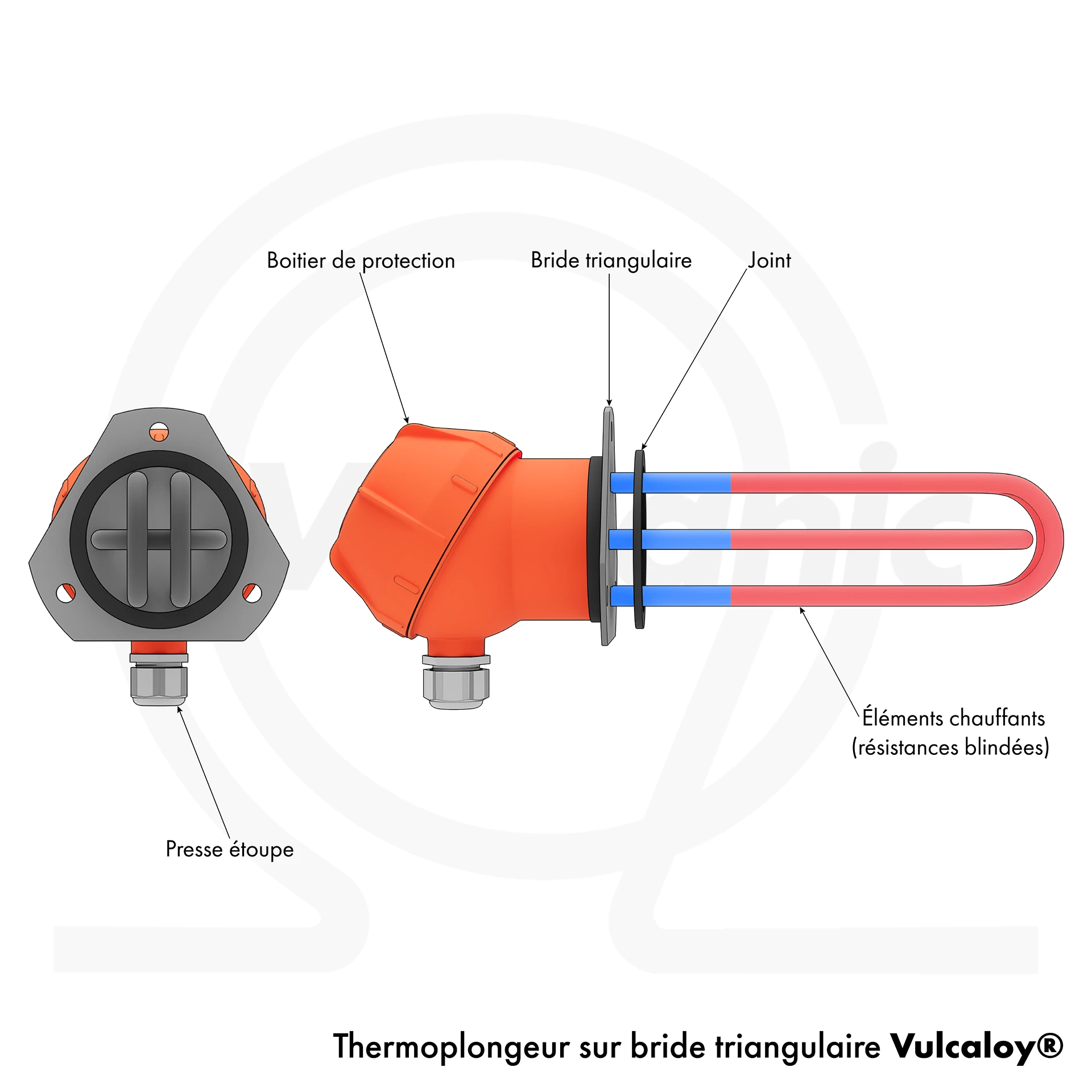
Flange immersion heaters consist of :
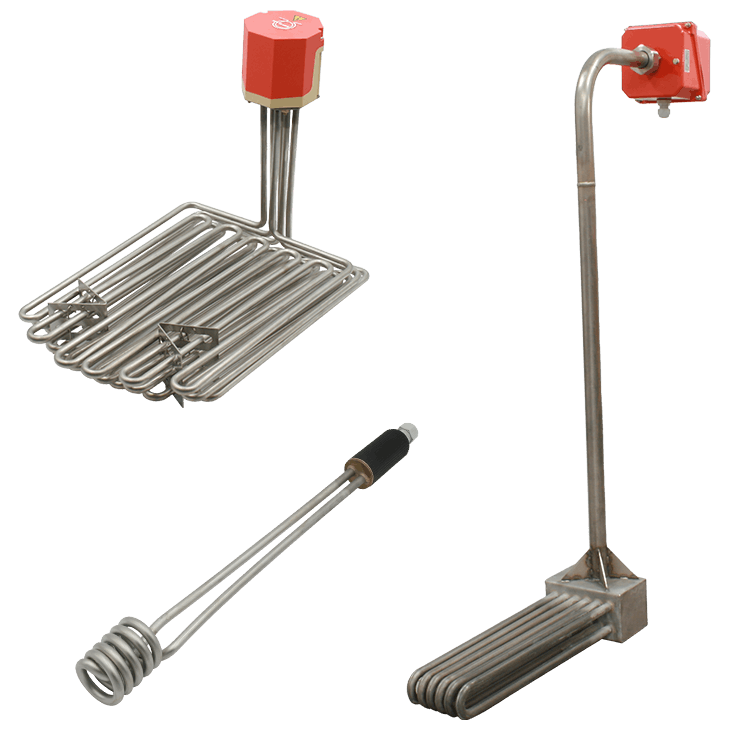
Shielded electrical resistors form the heater core of the immersion heater. Their quantity and diameter (8, 10.2 or 16 mm) vary according to the size of the mounting flange. Several materials are available (stainless steel 320, 321, 316L, 904L, Incoloy 600®, 625®, 800®, 825®, Titanium). Heating elements can be straight (monotubular), formed into single or double pins, or boron nitride haux flux rods (for up to 4x higher heat output).
A mounting flange ranging from DN32 to DN1000 (EN 1092-01) and from 1″1/4 to 54" (ASME B16.5) or even more for specific projects, PN 10 to 50. The materials available are just as varied: Steel (P245 GH, P280 GH,...), stainless steel (304L, 316L, 321, 321L, 316 Ti,...), Incoloy,... They can be of various shapes (circular, rectangular, or triangular as on the Vulcaloy® model).
Special spacers that do not impede fluid flow or the expansion of half-moon (1/2 empty or 3/4 empty) or thin pins.
Electrical terminals for immersion heater power supply. Several terminal models available (threaded, with holes, flat, Faston) or direct wire outputs.
The thermowell (optional) enables the installation of a safety or control device (probe, thermocouple or thermostat) for measuring fluid temperature, or a heating resistor. It consists of a sealed tube on the fluid side, open on the connector side to allow insertion of the measuring element.
The offset base is designed for mounting an enclosure to protect the connectors when they are offset. The offset is justified when the temperature of the fluid to be heated exceeds 110°C, to prevent overheating at the terminals.